


Dane & Saxon Settlement
Our village is most probably a combination of both Dane (Viking origin) and Anglo-Saxon settlements.
‘Norwegians’ farm/settlement’ ‘South’ is a later addition to distinguish from Temple Normanton and Normanton.
- Norðman (Old English) A Northman, a Norwegian.
- tūn (Old English) An enclosure; a farmstead; a village; an estate.
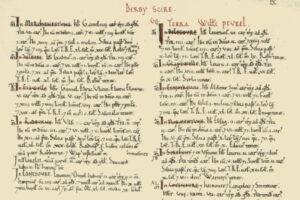
Domesday Book
Land of William Peverel
Tenant-in-chief in 1086: William Peverel.Households
- Households: 6 villagers. 1 smallholder.
Land and resources
- Ploughland: 2 ploughlands. 1 lord’s plough teams. 1 men’s plough teams.
- Other resources: Meadow 5 acres. Woodland 1 league & 4 furlongs * 4 furlongs mixed measures.
Valuation
- Annual value to lord: 10 shillings in 1086; 1 pound in 1066.
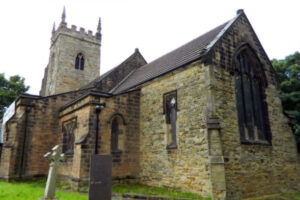
St Michael & All Angels
The Diocese of Derby – Parish Churches account dates the church to 1137. The Church was extended and refurbished in the 1870’s.
The church includes some original decorative carving around the vestry door, a piscina set in the wall, and a medieval font. The doorway on the south side is Norman and the arcade of three arches on two octagonal piers separating the nave and aisle is also of that period.
The windows are mostly Perpendicular, to which style the tower also belongs, and may date from 1440. Four crocketed pinnacles were added in 1813. The church includes a ring of six bells, the oldest being 1630-40, another dating 1654. The south aisle, organ chamber and vestry were added in 1878, when the church was “entirely rebuilt except for the tower and north aisle”.

Medieval Industry
Although it was a largely farming settlement South Normanton also added tanning (the process of turning animal hide into leather) as a secondary industry during medieval times, using the bark of the oak and birch, both plentiful in the surrounding area.
Tanning was a dirty job, even by medieval people’s standards. Tanners enjoyed the exclusive right to purchase cow hides from butchers and the blood, dirt, manure, hooves, and horns that went with them. During the long tanning process the tanner rinsed the raw material in a local waterway or well. Not very nice for the local residents or villagers downstream.
This centred around the ‘Old Market Place’ area of Sporton Lane, Main Street and Water Lane.

Revell's of Carnfield
Carnfield Hall and the surrounding 90 acre estate was traditionally the seat of the ‘Revell’ family.
As ‘Lords of the Manor’ beginning with Hugh Revell in 1502 this Grade II listed country house was developed and improved over their 300 years of ownership. Robert Revell, who was unfortunately murdered in the hall 1714 by his servants. His tomb can be found in St Michaels Church.
The last Revell at Carnfield as Tristan Revell who died in 1797 without children and the estate passed to his cousins.
The hall as passed through various owners over the past two hundred years including the ‘Radford’ family in 19th Century, James Cartland who carried out the restorations during the late 1980’s and 1990’s and now Carnfields current owner and custodians ‘Graham and Heidi Oliver’ and their family.

Jedediah Strutt
South Normanton is the birthplace of Jedediah Strutt who could be seen as one the fathers of the ‘Industrial Revolution’ and a pioneer of the cotton spinning industry in Derbyshire.
Strutt was born in 1726 to a farming family and served an apprenticeship as a ‘Wheelwright’ in Findern, Derby. In 1759 he patented the ‘Derby Rib Machine’ for knitting cotton stockings and created a successful silk knitting business. In 1769 he went into partnership with Samuel Need and Richard Arkwright and established the world’s first water powered cotton spinning mill on the River Derwent in Cromford. Strutt also built cotton mills in Belper and Millford.
He died in 1796 and was buried in a vault under the ‘Unitarian Chapel’ he built in Belper.
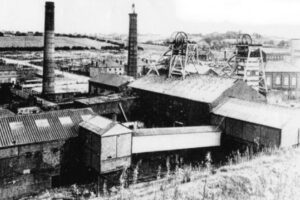
Our Mining Heritage
Our village began to steadily grow in 19th century with the rapid expansion of the Derbyshire coalfield. Although coal had been mined or outcropped in the area since 1600’s it was the opening of ‘A Winning (Blackwell)’ colliery in 1871 and ‘B Winning (Hilcote)’ in 1875, by the Blackwell Colliery Company that South Normanton took on its existing character.
South Normanton Colliery or ‘Winterbank / Wincobank Pit’ as it was locally known was sunk in 1893-1894 and brought even more miners and their families into the village. To accommodate the this growing population rows of terraced houses were built the streets around Victoria Street, Peel Street, South Street, Albert Street, Carter Lane and Berristow Lane. Other amenities began to appear like shops, chapels, schools and of course pubs quite a few of them.
By 1881 ‘A Winning’ had the largest output of coal in Derbyshire and employed around 500 men.
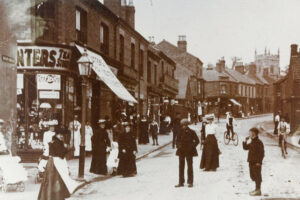
The Village Thrives
From the early 1900’s the village continued to grow and prosper with new shops, businesses and public houses opening along the High Street, Market Street and in the Market Place.
These also included a boot makers ‘Hiltons’ for the coalminers boots, Hunters Tea Stores, Tobacconists, Furniture and Haberdashery shops and various butchers, bakers and green grocers.
Did you know even our very own purpose built cinema the ‘Picture Palace’ opened on 25th September 1911 on New Street.
1911 also saw the opening Hamlet Lane Infant School now Glebe Junior School.

Mining Disaster
Coal mining was a very dangerous occupation and tragedy struck South Normanton on 15th February 1937 when a underground explosion ripped through the ‘Waterloo Seam’ of the Winterbank Pit at around 9.00pm followed by a second explosion about 20 to 30 minutes later.
The South Normanton Colliery explosion claimed the lives of 8 men and seriously wounded 3 others.
The men who died were:
- Edwin Samuel Hill – Aged 19
- John Marriott – Aged 38
- Willis Lambert – Aged 45
- Henry Willis – Aged 59
- Everett Rees – Aged 54
- John Vardy – Aged 25
- Frederick Pride – Aged 30
- Percy Ansell – Aged 21
Those men severely burned were:
- Isaac W. Petts – Aged 69
- John Samuel Thornley – Aged 27
- John Johnson – Aged 30
The M1 Arrives
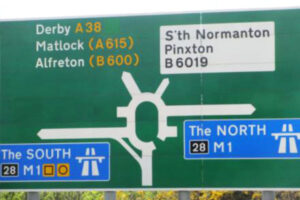
The M1 Motorway from London to Leeds was initially opened in 1959 with the 53.5 mile first phase section between Slip End to Crick.
The second phase between Rugby and Leeds was built in a series of extensions from 1965 to 1968. As the motorway moved north through the East Midlands it passed by Leicester and Nottingham before cutting through South Normanton and Pinxton at the Junction 28 ‘Pinxton Interchange’.
The new motorway not only cut down travelling time to surrounding cities of Derby, Nottingham and Sheffield it also provided easier access to the North and South of the country. This in-turn attracted new industries and business to move into the region to bolster the already declining coal industry.
Summer Fun & Junction 28
The 1970’s saw the creation of the ‘Junction 28 Arts Project’ by Huw Champion warden at the Frederick Gent Community Centre and was then based in the New Street Centre.
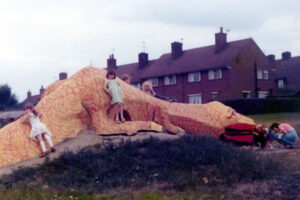
Throughout summer school holidays the team at Junction 28 carried out arts based activities with the local children on the South Street recreation ground (‘Bottom Rec’) and Market Street recreation ground (‘Top Rec’). These activities included an open air theatre group, a puppet group and a group using inflatables. The arts project also built the concrete dinosaurs one of which can still be found on the South Street recreation ground.
Later in 1984 Junction Arts would acquire and begun to renovate its own premises, the former cinema the ‘Picture Palace’ and they became a registered charity and limited company.
Junction 28 are now ‘Junction Arts‘ and are based in Chesterfield.

The Death of Coal
Modern day ‘South Normanton’ had been built around the success of the local coalfields in Derbyshire and Nottinghamshire but the 1980’s saw the final decline and death of one UK’s most important economic industries. The change from coal powered steam to diesel and electric locomotives and the onset of cheaper energy resources like North Sea oil and gas and nuclear power began to make coal obsolete.
The 1984 ‘Great Miners Strike’ saw the defeat of the once powerful miners unions and accelerated the steady drip of mine closures thought the country. Although the ‘Winterbank Pit’ had closed in 1957, the adjacent land across in the ‘Castlewood’ area had become the transport base for No. 4 Area of the NCB (National Coal Board) and still employed a large local workforce.
The coal mines had been the lifeblood our local economy and communities for well over a century. With the closure of Shirebrook & Markham Collieries in 1993 along with the majority of other local pits, South Normanton was at the end of an era and facing an uncertain future.
The Village Grows
South Normanton had continued to slowly grow through the second half of the 20th Century with both new council and private housing being built across the village. Our secondary school ‘Frederick Gent School‘ was built in 1958 and provided much need modern educational facilities to ever growing population.
The 1970’s and 80’s also saw the start of new housing developments on the ‘Broadmeadows’ and the ‘Rippon Homes’ estates which both grew and expanded well into the 1990’s.
In 1994 The Post Mill Centre opened its door to the public as our new purpose built community and events centre with its own bar and several rooms for hire.
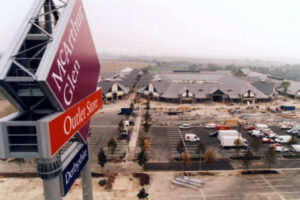
The decade accumulated with the opening of the new McAuthur Glen Shopping Outlet (Designer Outlet East Midlands) in October 1998 which brought a new lease of life to the old NCB transport depot and much needed jobs into the local area.
Did you know that there are ‘Coal Mining’ murals at the outlet paying tribute to our long coal mining heritage?

A New Millennium
A new millennium brought in even more changes to our village and community with new housing developments being built across the parish including the ‘Turnley Road’ estate off Carter Lane East, the Wimpy Homes ‘Weaver Gardens’, and the new Advant Homes ‘Babington Quarter’ to name just a few.
We also saw the expansion of the ‘Post Mill Centre’ and development and opening of ‘The Hub’ joint service centre in 2011 which includes facilities for:
- South Normanton Pre-School Nursery
- The Village Surgery – GP Practice
- South Normanton Library
- Bolsover District Council Office
- South Normanton Parish Council Office
- Community Police Office
- Derbyshire Community Health Services
- Adult Community Education Service
The Hub also features “The Skylight Apartments’ with 24 modern flats available for private let.
So as our parish continues to grow and thrive let’s look back at our long and interesting history and look forward to a bigger and brighter future for our ‘Big’ little village.